



Introduction
Perforated aluminum sheet is everywhere in construction. You see it on facades. You see it on ceilings. You see it on railings and noise barriers. It has many holes. The holes let air and light pass through. The holes also make buildings look better.
A 2026 report from QYResearch says the global perforated metal products market is still growing. Building and architecture is one of the biggest application areas. ArchDaily also shows many projects. These projects use perforated panels for daylight control, sun shading, and decoration.
So let me walk you through the top five applications. I will keep it simple. I will use short sentences. And I will tell you what you need to know.

Perforated Aluminum Sheet for Building Facades
Building facades are one of the biggest uses. Architects use perforated aluminum sheet for building facades all the time. They use it for curtain walls. They use it for exterior cladding. They use it for decorative panels.
Perforated aluminum sheet has several benefits for facades. First, it is lighter than glass. It is lighter than stone, too. Second, it is cheaper than glass and stone. Third, you can make different hole patterns. This makes buildings look more unique.
Common materials include aluminum. They also include stainless steel. And they include galvanized steel. Aluminum is light. It resists corrosion. It is easy to process. Stainless steel is strong. It has a long life. Galvanized steel is low-cost. It is good for tight budgets.
During installation, workers first fix the sheets to a frame. Then they connect the frame to the building structure. They leave gaps between panels. The gaps allow for thermal expansion and contraction.
Sun Shading Systems
Perforated aluminum sheet for sun shading is also very common. Architects install it outside windows. Or they install it in front of glass curtain walls.
Perforated aluminum sheet blocks part of the sunlight. This keeps indoor spaces cooler. At the same time, the holes let air move. So it does not completely block the wind.
The U.S. Green Building Council (USGBC) says shading design can reduce building energy use. A perforated aluminum sheet shading system is a simple and effective method.
The most common material is aluminum alloy. Aluminum alloy is light. It does not rust. You can powder-coat the surface. You can choose the color.
The hole pattern and open area ratio are important. If the open area is too low, shading is weak. If the open area is too high, it cannot block the sun. In general, the open area is between 30% and 50%.

Interior Ceilings
Perforated aluminum sheet is also used for railings and stairs. You see it on footbridges. You see it on platforms. You see it on stairs and escalators.
Perforated sheet railings have several advantages. First, they are safe. Second, they allow airflow. Third, they look good.
Compared with glass railings, perforated sheet railings do not break easily. Compared with solid panel railings, perforated sheet railings have lower wind resistance. So they are better for outdoor use.
Common materials include carbon steel. They also include stainless steel. And they include aluminum. Carbon steel needs painting or galvanizing. Stainless steel can be used directly. Aluminum is light. It is good for indoor use.
Stair treads also use perforated sheets. The holes provide slip resistance. The holes also drain water. So outdoor stairs often use perforated sheet treads.
Acoustics and Sound Insulation
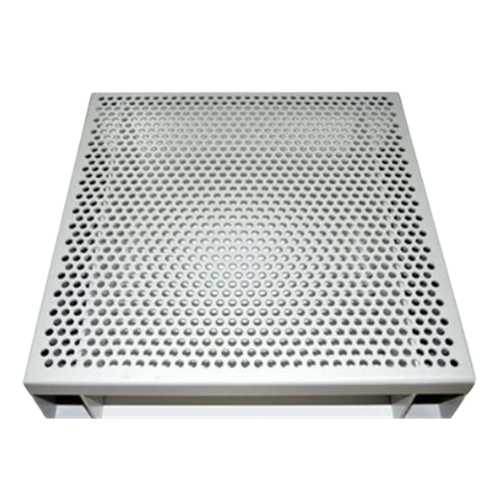
Perforated aluminum sheet is also important for acoustics. It is important for sound insulation, too. You see it on highway noise barriers. You see it in machine rooms. You see it in theaters and stadiums.
Perforated sheets do not absorb sound by themselves. But they let sound enter the acoustic material behind them. The acoustic material is usually rock wool. It can also be glass wool. After sound enters, the material absorbs it. This reduces noise.
The common open area is 30% to 45%. The hole diameter is usually 5 mm to 10 mm. If the holes are too small, sound cannot enter. If the holes are too large, the absorption effect is poor.
Common materials are galvanized steel. They also include aluminum. And they include stainless steel. Outdoor noise barriers usually use galvanized steel. Galvanized steel resists corrosion. It is also affordable.
The QYResearch report says the filtration and environmental protection sector is also growing. Acoustics and sound insulation is part of that. Urban noise regulations are getting stricter. So the demand for perforated sheet noise barriers is also increasing.
Five Major Applications
| Application | Main Function | Common Materials | Typical Location |
|---|---|---|---|
| Building Facades | Decoration, shading, ventilation | Perforated aluminum sheet, stainless steel, galvanized steel | Curtain walls, exterior walls |
| Sun Shading Systems | Reduce solar heat, ventilation | Perforated aluminum sheet, stainless steel | Outside windows, in front of glass walls |
| Interior Ceilings | Sound absorption, light transmission, decoration | Perforated aluminum sheet, galvanized steel | Corridors, halls, offices |
| Railings and Stairs | Safety, ventilation, aesthetics | Carbon steel, stainless steel, aluminum | Stairs, platforms, footbridges |
| Acoustics and Sound Insulation | Sound absorption, noise reduction | Galvanized steel, perforated aluminum sheet | Noise barriers, machine rooms, theaters |
FAQ
Q: Will perforated sheets rust on building facades?
A: It depends on the material. Galvanized sheets resist corrosion. Stainless steel sheets resist corrosion, too. For coastal areas, you should use 316 stainless steel. Plain carbon steel needs painting. It also needs galvanizing. Otherwise, it will rust.
Q: Do perforated sheets affect building daylighting?
A: Yes. The hole size determines light transmission. The hole density also determines light transmission. Large holes let in more light. Small holes let in less light. You should choose based on your needs. You should do this during design.
Q: Can perforated sheets absorb sound?
A: Yes. The holes let sound waves enter the acoustic material behind them. The common open area is 30% to 45%. The hole diameter is usually 5 mm to 10 mm.
Q: Is it difficult to install perforated sheets?
A: No. You can make them into standard panels. You can also customize them. Workers fix them with frames. They also use hangers or screws. Installation is fairly fast.
Q: Are perforated sheets expensive?
A: They are cheaper than glass curtain walls. The price depends on material. It also depends on thickness. It depends on hole pattern and quantity, too. Aluminum and galvanized steel are relatively cheap. Stainless steel is more expensive.
Q: How long do perforated sheets last?
A: It depends on the material. It also depends on the environment. Stainless steel can last for decades. Galvanized steel can last for over ten years. Carbon steel with painting can also last a long time. Regular maintenance can extend the service life.
Conclusion
Perforated aluminum sheet has many applications in construction. It can be used for facades. It can be used for sun shading. It can be used for ceilings. It can be used for railings. It can be used for sound insulation.
Each application has different requirements. The requirements include material, hole pattern, and open area. Choosing the right material makes buildings safer. It makes them more energy-efficient. It makes them more attractive.
If you are working on a building project, take a closer look at perforated aluminum sheet. It may be a simple and practical choice.
At Xiongqian, we manufacture perforated aluminum sheet for construction projects. We focus on quality, delivery, and service. If you need a reliable supplier, feel free to contact us.
