



introduction
Buyers often only look at the unit price when buying perforated sheet. This is a huge trap. Some factories offer extremely low prices. However, your final total cost ends up being shockingly high. Why? Because the low-price quotation hides many “invisible costs.”
We will focus on three key points. First is tooling costs. Second is material yield. Third is surface treatment.
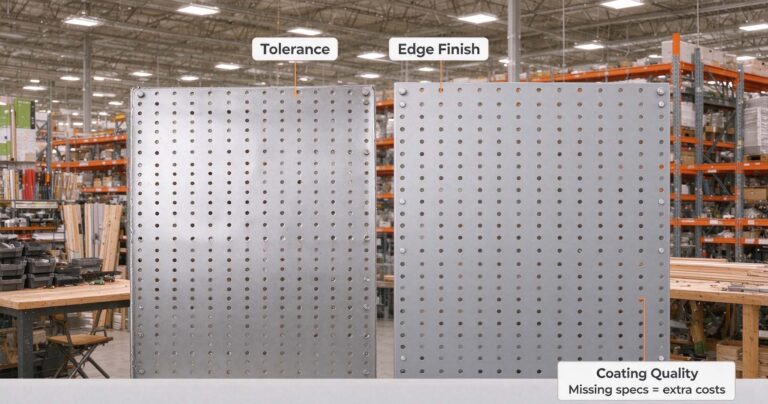
Trap 1: How Are Tooling Costs Calculated? Cheap Molds Are a Nightmare
Buyers often ask factories: “How do you charge for tooling?” To win orders, some low-price factories claim “free tooling.” You must be highly alert when you hear this. This is the first step in a trap.
Producing perforated sheets requires molds. A professional factory invests heavily to make a high-quality precision mold. If the order volume is small, charging a one-time tooling fee is very reasonable.
How do low-price factories make tooling free?
They use low-quality carbon steel to make molds. This mold has terrible hardness. After the punch press strikes a few thousand times, the mold edges wear out severely.
What is the consequence?
Once the mold wears out, the punched hole edges produce massive sharp burrs. These burrs cut hands and affect assembly. Buyers must spend a lot of manual labor to grind the burrs. Buyers also face a high defect rate. Furthermore, cheap molds cannot guarantee hole tolerance. Your mounting frames won’t fit. This extra labor and material waste costs much more than the tooling fee you saved.
Trap 2: The Math Game of Material Yield, Who Pays for the Scrap?
Steel plates cost money. Every hole punched becomes scrap. The waste rate (Material Yield) directly decides the true cost of the perforated sheet.
Engineers at professional factories design precise nesting layouts before making molds. Engineers calculate how to arrange holes to save the most material. For example, your drawing requires a margin. A good layout nests two sheets together to share the scrap edges. This is optimization.
How do low-price factories do it?
Small factories skip the design time. They put the whole steel plate into the machine. They punch one part and throw away the leftover edges. Worse, perforated metal mesh often has a high open area. If the open area reaches 50% or 70%, over half the original steel plate weight becomes scrap.
If the factory does not optimize, the waste rate is huge. Material costs soar. The factory never pays for this extra scrap. They quietly add it to your unit price. So, the unit price looks low. But you are actually paying for severely wasted steel.
Trap 3: Cutting Corners on Surface Treatment, The Endless Maintenance Cost
This is the most fatal trap. Low-price orders save money by cutting surface treatment processes.
A qualified anti-corrosion coating needs a strict pre-treatment process. Step one, workers use chemicals to degrease completely. Step two, workers acid-pickle to remove rust. Step three, workers phosphating to increase adhesion. Finally, workers apply powder coating or hot-dip galvanizing.
How do low-price factories do it?
To save environmental and labor costs, they skip pre-treatment. The steel plate still has oil and micro-rust. Workers spray paint directly on it. The surface looks bright. But the adhesion is terrible.
After a few months, with humidity or UV exposure, the coating peels, flakes, and chalks. The carbon steel underneath loses protection and rusts rapidly.
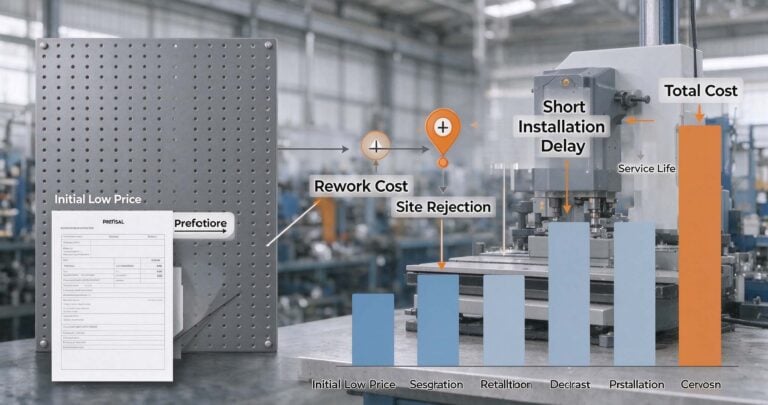
Real Case Study: The Price Fog of Custom Facade Panels
To make it clear, let’s take a product from our website: Custom Architectural Facade Perforated Aluminum Panels (Size 1m x 2m, Hole 8mm, Open Area 35%, PVDF Coating). Quantity: 5,000 square meters.
Factory A (Low-Price) Quote: $21/sqm. Total: $105,000.
Factory B (Professional) Quote: $30/sqm. Total: $150,000.
Factory A is $45,000 cheaper. But is it really? Let’s look at hidden costs.
Burr Labor Cost: Factory A has bad molds. They need extra $2/sqm for manual deburring. Total: +$10,000.
Scrap Loss: Factory A has 40% waste. Factory B has 25%. Factory A adds this material cost to the price.
Fatal Maintenance Cost: Factory A skipped pre-treatment. After 1 year, the coating peels. Because it’s high-altitude, scaffolding and repainting cost $60/sqm. Total maintenance: $300,000.
Downtime Loss: Re-construction stops the building for weeks. Rent loss is not even included.
Total Math:
Factory A Total Cost = $105k (Initial) + $10k (Labor) + $300k (Rework) = $415,000.
Factory B Total Cost = $150k (Initial) + $0 (Maintenance) = $150,000.
This is the truth of low-price factories. The unit price is low. The total cost is absurdly high.
Total Cost Comparison Table
Here is the deep comparison of cost components:
| Cost Component | Low-Price Factory (Low Quote) | Xiongqian (Reasonable Quote) | Impact on Final Project Total Cost |
|---|---|---|---|
| Initial Unit Price | Looks extremely low | Normal market price | Low-price factory leads at the start |
| Tooling Quality & Lifespan | Cheap steel, fast wear, high burrs | High-quality alloy mold, precise tolerance, smooth edges | Low-price factory causes high deburring labor and defect rates |
| Nesting & Material Utilization | Random layout, extreme waste | Systematic optimized nesting, max utilization | Low-price factory passes high scrap costs to you |
| Pre-treatment Process | Skips degreasing/rust removal, direct paint | Strict degreasing, pickling, phosphating | Low-price factory coating peels easily |
| Coating Thickness & Adhesion | Extremely thin, poor adhesion, chalks and rusts | Meets AAMA 2605 standards, thickness verified | Low-price factory faces massive repair costs |
| Quality Control (QC) | Almost no QC, defects shipped | Strict size and surface inspection, reports provided | Returns cause severe project delays |
| Overall Lifecycle Total Cost | Extremely High (Full of hidden traps) | Lowest (Worry-free and maintenance-free) | Overall, the professional factory is the real money-saver |
FAQ
Why is your lead time 31 days?
Our 31-day lead time is strict. It includes material prep, precision processing, surface treatment, and QC. This guarantees quality in extreme climates. We do not offer early delivery.
Why are your prices higher than other trading companies?
Because we are a direct factory. We guarantee quality. We have a professional QC team. We never cut corners on materials and processes.
Is there an extra cost for custom sizes or special hole types?
No extra charge. Within the specified range, we only adjust production parameters. We do not charge customization fees.
Is quality inspection conducted before shipment?
Yes. Every product is strictly checked before shipment. Checks include size, surface, and structure. We provide reports.
Got any certifications?
We have ISO9001 and CE. We also have audited regulatory licenses.
Conclusion
Buyers must never look at the unit price alone when buying a perforated sheet. Burrs from cheap molds, scrap steel from bad nesting, and rust from skipped surface treatments will multiply your project’s total cost.
If you are looking for truly reliable perforated metal sheet suppliers, contact Xiongqian. We provide transparent, reasonable quotes without hidden traps. Our high-quality perforated metal mesh ensures your project is done right the first time.
