



introduction
The Middle East environment is very harsh. Summer temperatures often exceed 50°C. UV light is extremely strong. Sandstorms are frequent. Coastal cities also face severe salt spray. Architects must install shading systems on building exteriors. perforated sheet is the most ideal choice today.
We supply metal facades for many landmark projects in the Middle East. Today, I will deeply analyze the two most important parameters for external shading: open area and hole types.
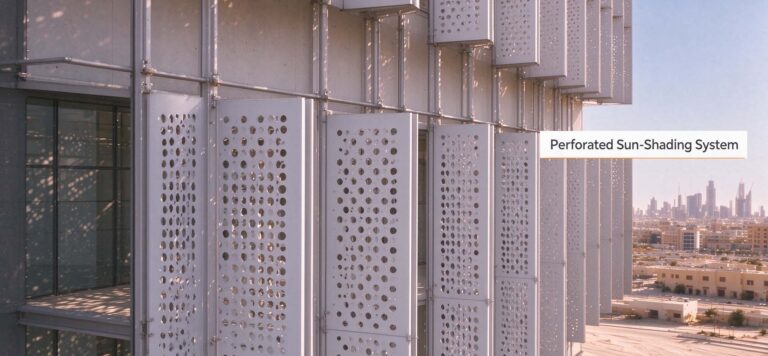
Why Must the Open Area Be Locked at 30% to 50%?
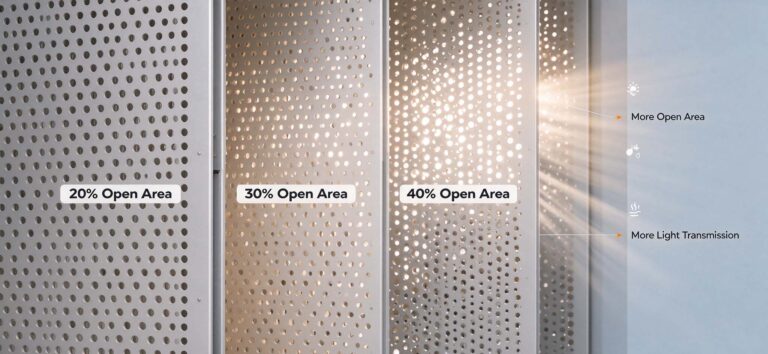
This is the golden rule of fluid dynamics. The Middle East solar radiation is too strong. If the open area is set wrong, the whole shading system fails.
If the open area is below 30%:
First, hot air accumulates. The sun heats the aluminum panel. The air behind the panel gets hot. There are too few holes. Hot air cannot escape. This is like wearing a non-breathable down jacket. Second, wind resistance is huge. When a sandstorm hits, strong winds hit the solid panel. The massive wind load severely deforms the panel. Developers must spend heavily to thicken the steel frames to resist wind.
If the open area is above 50%:
Shading is completely lost. Sunlight passes straight into the room. According to ASHRAE data, direct sunlight spikes the AC load of glass facades by over 40%. The building’s electricity bill becomes astronomical.
30% to 50% is the perfect balance.
In this range, perforated metal mesh creates a perfect “chimney effect.” The holes block harsh direct light. Breeze passes freely through the holes. When the air behind the panel is heated and becomes lighter, hot air flows upward and escapes through the holes. This lowers the indoor AC load and ensures heat dissipation on the leeward side.
Micro-Comparison of Three Designs
Different hole types have completely different physical responses to sun and sand.
1. Round Holes
Round holes are the most basic design. Force distribution is extremely even. Processing cost is the lowest.
Use: South or North facades. Sun angles are higher here. Round holes cut light evenly.
Weakness: Average sand resistance. Sand particles easily pass through and hit the glass.
2. Slotted / Louver Holes
Slotted holes look like capsules. Louver holes have slanted raised edges.
Use: Windward facades and high sandstorm areas.
Strength: The raised edges of louver holes change airflow direction. They let wind pass but block flying sand. Also, the raised edges block slanted harsh sunlight and guide hot air upward.
3. Square / Hexagonal Holes
These are high-precision types. Hexagons are like honeycombs. Structural strength is extreme. Looks very modern.
Use: Landmark commercial complexes.
Weakness: Square holes have four right angles. They easily trap sand. Cleaning is very difficult. Not recommended for large areas in high sandstorm regions.
Material Armor: How to Survive Heat and Abrasion?
Choosing the hole type is just the first step. Materials must withstand the Middle East extreme climate.
Choose 5052 Aluminum Alloy
Pure aluminum cannot handle it. Middle East projects prefer 3003 and 5052. Specifically, 5052-H32 aluminum. It contains magnesium. Salt spray resistance is extreme. Persian Gulf projects must use it.
Coating Must Be PVDF
Standard polyester powder coating chalks severely outdoors in 5 years. The Middle East must use PVDF (fluorocarbon) coating. It meets AAMA 2605 standards. The carbon-fluorine bonds are extremely stable. Coating thickness must reach 30 microns. Sand cannot scratch it. UV cannot break it. It keeps color for 20 years.
Panel Thickness and Thermal Expansion
Shading panels are not indoor decor. Middle East temperature swings are huge. Aluminum expands and contracts with heat. Panel thickness should be 2.5 mm to 3.0 mm. During installation, expansion joints must be reserved around the panel. Flexible connectors must be used. This prevents panels from bowing in high heat.
Application Comparison of Different Open Areas
This table summarizes the real engineering performance of different open areas in Middle East climates:
| Open Area | Shading & Glare Control | Ventilation & Heat Dissipation | Sand Resistance & Structural Load | Recommended Scenario |
|---|---|---|---|---|
| Below 30% | Extreme (almost fully blocked) | Poor (hot air trapped inside) | Huge wind resistance, needs thicker frames | Specific facades needing extreme privacy |
| 30% – 40% | Excellent (blocks harsh direct light) | Good (hot air escapes effectively) | Balanced force, safe and reliable | High-rises with severe west sun |
| 40% – 50% | Medium (retains some natural light) | Excellent (smooth ventilation) | Good airflow, low wind resistance | Commercial complexes, view-needed facades |
| Above 50% | Weak (massive direct sunlight) | Excellent | Vulnerable to sandstorm impact | Not recommended for external shading alone |
FAQ
Why is your lead time 31 days?
Our 31-day lead time is strict. It includes material prep, precision processing, surface treatment, and QC. This guarantees quality in extreme climates. We do not offer early delivery.
Why are your prices higher than other trading companies?
Because we are a direct factory. We guarantee quality. We have a professional QC team. We never cut corners on materials and processes.
Is there an extra cost for custom sizes or special hole types?
No extra charge. Within the specified range, we only adjust production parameters. We do not charge customization fees.
Is quality inspection conducted before shipment?
Yes. Every product is strictly checked before shipment. Checks include size, surface, and structure. We provide reports.
Got any certifications?
We have ISO9001 and CE. We also have audited regulatory licenses.
Conclusion
For Middle East shading, do not just buy any panel. Open area must be locked at 30% to 50%. Use slotted holes for windward sides. Use round holes for west sun. Coating must be PVDF. Do these right, and the perforated sheet delivers maximum energy savings.
If you need reliable perforated metal sheet suppliers, contact Xiongqian. We provide perforated metal mesh meeting Middle East standards.
