




Stainless Steel Grating
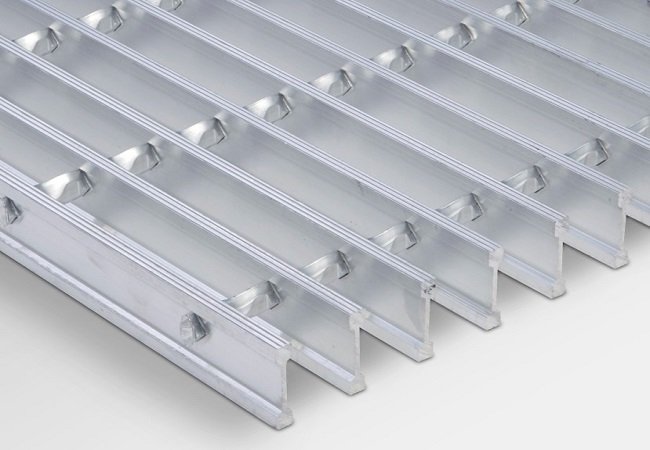
Stainless steel grating is an open-grid load-bearing panel manufactured from 304, 304L, 316 or 316L austenitic stainless steel bearing bars and cross bars, conforming to ASTM A666. The chromium oxide passive layer provides inherent corrosion resistance without any applied coating, making it the standard choice for food processing, pharmaceutical, chemical, wastewater and marine environments. Available in welded, press-locked and swage-locked construction, with pickled and passivated finish as standard.
Stainless Steel Grating Quick Specs
| Parameter | Range |
|---|---|
| Material Grade | 304 / 304L / 316 / 316L (ASTM A666) |
| Construction | Welded (WS) / Press-Locked (DTS) / Swage-Locked (SLS) |
| Bearing Bar Height | 3/4″ – 7″ (19 mm – 178 mm) |
| Bearing Bar Thickness | 1/8″ – 1/2″ (3 mm – 12 mm) |
| Bearing Bar Spacing | 19 space (1-3/16″) / 15 space (15/16″) / 11 space (11/16″) / 7 space (7/16″) |
| Cross Bar Spacing | 4″ (standard) / 2″ (optional) |
| Standard Panel Size | 3′ × 20′ / 3′ × 24′ (custom cut-to-size available) |
| Surface Profile | Plain / Serrated |
| Finish | Pickled & Passivated (standard) / Electropolished (optional) |
304 vs. 316 Stainless Steel
Both 304 and 316 are austenitic stainless steels with a chromium oxide passive layer that provides corrosion resistance without coating. The key difference is molybdenum: 316 contains 2–3% molybdenum, which significantly improves resistance to chloride-induced pitting and crevice corrosion. 304 is the economical choice for general indoor wet environments, food production and clean utility areas. 316 is specified where chlorides are present — coastal air, seawater splash, brines, wastewater with hydrogen sulphide, and chemical process areas.
| Grade | Molybdenum | Chloride Resistance | Typical Environment | Relative Cost |
|---|---|---|---|---|
| 304 / 304L | None | Moderate — general atmospheric and fresh water | Indoor food processing, commercial kitchens, clean utility rooms | Baseline |
| 316 / 316L | 2–3% | High — resists chloride pitting and crevice attack | Coastal walkways, marine access, wastewater, chemical plants, desalination | Higher |
316 is not immune to every chemical or seawater condition. Warm seawater, stagnant chloride solutions, deposits and poor cleaning can still attack 316. For continuous immersion or severe offshore exposure, 316L or a higher-alloy grade should be evaluated. Grade selection should be based on the actual operating environment, not the grade name alone.
Stainless Steel Grating Construction Types
Welded Stainless Grating (Type WS)
Bearing bars and cross bars are forge-welded at every intersection. The strongest and most economical stainless construction, with a fully fused intersection that withstands demanding conditions. Available in 19, 15 and 11 space bearing bar centers.
Press-Locked Stainless Grating (Type DTS)
Cross bars are pressed into slotted bearing bars without welding. Produces a clean, uniform surface and high rigidity. Preferred for architectural sunscreens, grilles and infill panels where a finished appearance matters.
Swage-Locked Stainless Grating (Type SLS)
Hollow tube cross bars are hydraulically swaged into pre-punched bearing bars, with the cross bars sitting slightly below the top surface. Popular for close-mesh and ADA-conforming applications, including vault covers and entrance mats.
Applications
Food Processing & Commercial Kitchens
Processing floors, wash-down areas, drain covers and equipment platforms where hygiene and resistance to cleaning chemicals are critical. 304 is the standard choice; 316 is specified for brine or chloride exposure.
Pharmaceutical & Clean Rooms
Platforms and drainage covers requiring a non-porous, easy-to-clean surface. Pickled and passivated finish removes heat tint and embedded contaminants, supporting hygiene compliance.
Wastewater Treatment & Chemical Plants
Trench covers, walkways and equipment platforms exposed to hydrogen sulphide, chlorides and process chemicals. 316 is the standard grade for this environment.
Marine & Coastal Infrastructure
Dock access, coastal walkways, desalination facilities and seafood processing plants. 316 or 316L is required for salt spray and chloride-rich conditions.
Surface Finish
Welding and cutting stainless steel leaves heat tint, embedded iron particles and a depleted chromium layer at the weld zone. Without removal, these areas become initiation sites for pitting corrosion, especially in chloride environments. Pickling uses acid to remove the heat-affected zone and restore the chromium oxide passive layer. Passivation follows, using an oxidising solution to complete the passive film. All Xiongqian stainless steel grating is pickled and passivated as standard after fabrication. Electropolishing is available as an upgrade for hygienic and high-purity applications, producing a brighter, smoother surface with further enhanced corrosion resistance.
| Finish | Process | Corrosion Performance | Typical Use |
|---|---|---|---|
| Mill Finish | No post-fabrication treatment | Baseline — heat tint and weld scale remain | Dry indoor, non-critical |
| Pickled & Passivated (standard) | Acid pickling + passivation | Restored passive layer, removes heat tint and contamination | Food, pharma, wastewater, marine |
| Electropolished (optional) | Electrochemical polishing after pickling | Bright, smooth surface, highest corrosion resistance and cleanability | Hygienic, high-purity, pharmaceutical |
Related Products



FAQ
Stainless Steel Grating — FAQ
Should I choose 304 or 316 stainless steel grating?
304 for general indoor wet environments, food processing and clean utility areas. 316 when chlorides are present — coastal air, seawater, brines, wastewater and chemical processes. The molybdenum in 316 provides the extra resistance to chloride pitting.
What does pickled and passivated mean?
Pickling removes heat tint, weld scale and embedded iron contamination from the surface after fabrication. Passivation restores the chromium oxide passive layer that provides corrosion resistance. Together they are the minimum recommended finish for stainless steel grating in corrosive or hygienic environments.
Is stainless steel grating load capacity different from carbon steel?
The load capacity depends primarily on bearing bar height, thickness, spacing and span — not on the alloy grade alone. Stainless steel has different mechanical properties from carbon steel, and load tables should be consulted for the specific grade and bar section. Fiber stress for 304 and 316 is typically 20,000 psi in published load tables.
Can stainless steel grating be cut and welded on site?
Yes, but site cutting and welding require proper post-treatment. Cut edges and weld zones must be pickled and passivated to restore corrosion resistance, or a suitable repair paste should be applied. Factory cut-to-size orders are pickled and passivated after fabrication, avoiding site touch-up.
What is the typical lead time for stainless steel grating?
Standard panels in 304 or 316 ship in 10–20 days depending on size and construction. Custom cut-to-size orders with pickling and passivation typically require 20–30 days after drawing approval.

Need a Stainless Steel Grating Specification?
Send your material grade (304 or 316), bearing bar size and spacing, panel dimensions, surface profile (plain or serrated), finish (pickled/passivated or electropolished), and the operating environment. We will confirm the specification and reply with a factory quotation within 24 hours.