




Mild Steel Grating
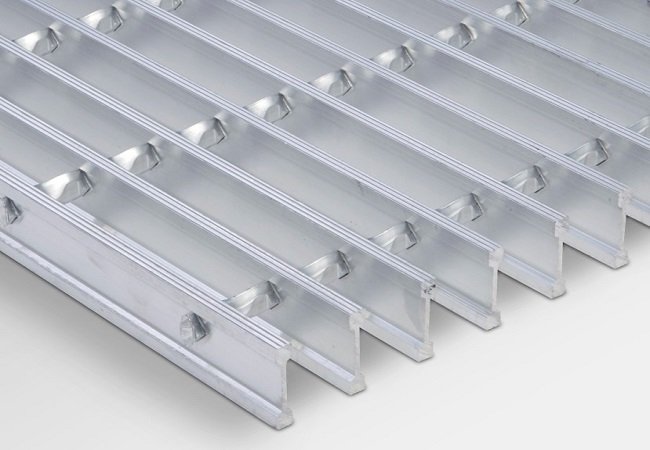
Mild steel grating — also referred to as low carbon steel or ASTM A36 bar grating — is the most widely specified open-grid flooring material for industrial and commercial projects. The low carbon content (max 0.26%) provides excellent weldability and ductility, while a yield strength of 36,000 psi minimum supports demanding load requirements. Available in welded or press-locked construction, plain or serrated surface, and hot-dip galvanized or painted finish for corrosion protection in outdoor and wet environments.
Mild Steel Grating Quick Specs
| Parameter | Range |
|---|---|
| Base Material | ASTM A36 / Q235 low carbon steel |
| Carbon Content | ≤ 0.26% |
| Yield Strength | ≥ 36,000 psi (250 MPa) |
| Tensile Strength | 58,000 – 79,800 psi |
| Construction | Welded (Type W) / Press-Locked (Type DT) |
| Bearing Bar Height | 3/4″ – 7″ (19 mm – 178 mm) |
| Bearing Bar Thickness | 1/8″ – 1/2″ (3 mm – 12 mm) |
| Standard Spacing | 19-W-4 (1-3/16″ bearing bar, 4″ cross bar) |
| Surface Profile | Plain / Serrated |
| Finish | Untreated (mill) / Hot-Dip Galvanized / Painted |
Mild Steel Grating Specifications & Load Reference
| Bearing Bar Size | Spacing Code | Approx. Weight (psf) | Max Pedestrian Span (deflection ≤ 1/4″) | Typical Application |
|---|---|---|---|---|
| 3/4″ × 3/16″ | 19-W-4 | ~5.5 | ~2′-6″ | Light walkway, screening |
| 1″ × 3/16″ | 19-W-4 | ~9.9 | ~3′-6″ | General walkway, platform |
| 1-1/4″ × 3/16″ | 19-W-4 | ~12.4 | ~4′-3″ | Platform, catwalk |
| 1-1/2″ × 1/4″ | 19-W-4 | ~16.7 | ~4′-9″ | Heavy platform, trench cover |
| 2″ × 3/16″ | 19-W-4 | ~14.1 | ~6′-0″ | Trench cover, long span |
| 2-1/2″ × 1/4″ | 19-W-4 | ~22.5 | ~7′-0″ | Heavy-duty platform |
| 3″ × 1/4″ | 19-W-4 | ~26.8 | ~8′-0″ | Industrial floor, vehicle area |
Span figures above are indicative for pedestrian comfort (deflection limit 1/4″). For vehicle loads, concentrated loads or critical installations, the bearing bar size must be confirmed against the actual uniform load, concentrated load and allowable deflection. NAAMM MBG 531/534 procedures are used for verification, with an allowable design stress of 18,000–20,000 psi for ASTM A36 bearing bars. Send your load and span requirements for a stamped calculation.
Mild Steel Grating Surface Finish
Mild steel grating has no inherent corrosion resistance. The finish determines service life in any environment where moisture, condensation or outdoor exposure exists. Untreated (mill finish) grating is suitable only for dry indoor applications and is the lowest-cost option. Hot-dip galvanizing after fabrication to ASTM A123 creates a metallurgical zinc-iron alloy layer that provides barrier and sacrificial protection; a minimum average coating of 610 g/m² (≈85 µm) is the common specification for steel grating.
Painted finishes are used for colour coding or mild indoor protection, but they do not match galvanizing for durability in wet or outdoor service.
| Finish | Corrosion Protection | Suitable Environment | Relative Cost |
|---|---|---|---|
| Untreated (Mill) | None — bare steel | Dry indoor only | Lowest |
| Hot-Dip Galvanized (ASTM A123) | Barrier + sacrificial zinc | Outdoor, wet, coastal, industrial | Moderate premium |
| Painted | Barrier only — damaged by chips | Dry indoor, colour coding | Low |
Galvanizing is performed after all cutting, welding and fabrication, so cut edges, welds and punched holes are fully coated. Site cuts must be repaired with a zinc-rich compound. For coastal or chloride-rich environments, 316 stainless steel or a higher-alloy material is recommended instead of galvanized mild steel.
Applications
Industrial Walkways & Platforms
The default material for factory mezzanines, operating platforms, catwalks and access routes. Welded construction with hot-dip galvanizing for outdoor or wash-down areas. 1″×3/16″ and 1-1/4″×3/16″ at 19-W-4 are the most common pedestrian specifications.
Trench & Drainage Covers
Mild steel grating with hot-dip galvanizing is widely used for trench covers, sump covers and drainage grates where vehicle or pedestrian loads are present. Bearing bar size is selected against the actual clear span and load class.
Stair Treads & Ladders
Serrated mild steel grating provides slip resistance for stair treads and ladder rungs. Hot-dip galvanized finish is standard for outdoor and industrial stairways.
Security & Fencing
Press-locked or welded mild steel grating is used for security screens, machine guards and fencing infill panels where a rigid open-grid barrier is required.
Welded vs. Press-Locked Mild Steel Grating
Both constructions use the same ASTM A36 bearing bars and cross bars. The difference is in the joint: welded grating fuses every intersection by resistance welding, producing a permanent metallurgical bond that handles impact and heavy loads. Press-locked grating presses slotted cross bars into bearing bars under high pressure, creating a mechanical interlock with no welds, no heat-affected zone and a cleaner, more uniform top surface.
Welded is the default for industrial platforms, mezzanines and heavy-duty flooring where strength and cost-efficiency dominate. Press-locked is preferred for architectural facades, public spaces, stair treads and visible installations where appearance and dimensional precision matter.
| Factor | Welded (Type W) | Press-Locked (Type DT) |
|---|---|---|
| Joint | Resistance weld at every intersection | Mechanical interlock, no weld |
| Strength | Higher impact and shear resistance | Adequate for pedestrian and light vehicle |
| Surface Appearance | Visible weld marks | Clean, uniform, no weld marks |
| Corrosion Risk | Weld heat-affected zones are potential initiation sites | No heat-affected zone; lower risk at joints |
| Typical Use | Industrial platforms, mezzanines, catwalks, heavy flooring | Architectural facades, public spaces, stair treads, visible areas |
| Relative Cost | Most economical | Moderate premium |
Related Products



FAQ
Mild Steel Grating — FAQ
Is mild steel grating the same as carbon steel grating?
Yes. “Mild steel” and “low carbon steel” are both used to describe the same family of material, typically ASTM A36 with a maximum carbon content of 0.26%. It is the standard base material for welded and press-locked bar grating.
Can mild steel grating be used outdoors?
Only with a protective finish. Untreated mild steel will rust quickly in wet or outdoor conditions. Hot-dip galvanizing after fabrication to ASTM A123 is the standard outdoor protection, with a minimum average coating of 610 g/m² (≈85 µm). For coastal or chloride-rich environments, stainless steel is the better choice.
What is the difference between welded and press-locked mild steel grating?
Welded grating fuses every intersection by resistance welding and is the stronger, more economical option for industrial platforms and heavy loads. Press-locked grating uses a mechanical interlock with no welds, producing a cleaner, more uniform surface for architectural and visible installations.
What is the typical lead time for mild steel grating?
Bearing bar size, spacing and span together determine load capacity and deflection. Pedestrian applications generally use a 1/4″ deflection limit for comfort; vehicle or concentrated loads require a specific calculation. Send your clear span, uniform load and any concentrated load, and we will confirm the bar size.
What is the typical lead time?
Standard panels ship in 7–15 days. Custom cut-to-size orders with banding, notching and hot-dip galvanizing typically require 15–25 days after drawing approval.

Need a Mild Steel Grating Specification?
Send your bearing bar size, spacing, panel dimensions, surface type (plain or serrated), finish (untreated, galvanized or painted), and load/span requirements. We will confirm the specification and reply with a factory quotation within 24 hours.