




Heavy Duty Grating
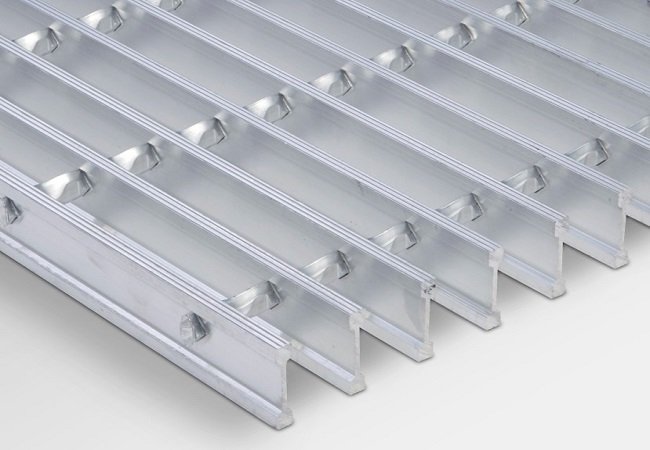
Heavy duty grating is bar grating engineered for concentrated and rolling loads that exceed pedestrian-rated flooring — vehicle traffic, forklifts, loading docks, bridge decks and airport trench covers. Where standard 19-W-4 pedestrian grating deflects or fatigues under repeated wheel loads, heavy duty grating uses deeper bearing bars (up to 7″), thicker sections, and riveted or heavy welded construction to maintain structural integrity under AASHTO H-15 through H-25 loading.
Available in carbon steel (bare, painted or hot-dip galvanized) and 300-series stainless steel.
Heavy Duty Grating Quick Specs
| Parameter | Range |
|---|---|
| Design Load Standard | AASHTO H-15 / H-20 / H-25 (vehicular); 1–5 ton forklift |
| Construction | Riveted (bridge deck / severe load) / Heavy welded |
| Bearing Bar Depth | Up to 7″ (178 mm); deeper sections engineered on request |
| Bearing Bar Thickness | 1/4″ – 1/2″ (6 mm – 12 mm); 3/8″ and 1/2″ for severe load |
| Bearing Bar Spacing | 15-W-4 / 19-W-4 / 22-W-4 / 30-W-4 / 38-W-4 (custom available) |
| Cross Bar | Twisted square or round, sized for standard or severe load |
| Deflection Limit | ≤ L/400 or 0.125″ (whichever is less) for vehicular tables |
| Max Simple Span | Limited to 8′-0″ in standard vehicular load tables |
| Finish | Bare / Painted / Hot-Dip Galvanized (ASTM A123) / Stainless mill or electropolished |
Riveted vs. Heavy Welded
Heavy duty grating is not defined by bar size alone. The joint detail determines fatigue life under repeated wheel loads. Riveted grating cold-presses truss-shaped reticuline cross bars onto parallel bearing bars, avoiding welded heat-affected zones that become crack initiation sites under cyclic loading. This is why riveted construction is the preferred choice for bridge decks, airport inlets and any application subject to impact and repetitive loads.
Heavy welded construction uses deep bearing bars and heavy cross bars to achieve high static capacity at lower cost, and remains appropriate for loading docks, plant floors and intermittent vehicle traffic where fatigue cycling is not the governing condition.
| Factor | Riveted Heavy Duty | Heavy Welded |
|---|---|---|
| Joint Mechanism | Cold-pressed reticuline cross bar | Resistance weld at every intersection |
| Fatigue Performance | Superior — no weld heat-affected zone | Adequate for static and intermittent traffic |
| Best Load Type | Repetitive impact, rolling wheel loads, bridge decks | Static, concentrated, intermittent vehicle |
| Typical Application | Bridge decks, highway inlets, airport trench covers | Loading docks, plant floors, industrial platforms |
| Relative Cost | Higher | Lower |
Heavy Duty Grating Load Reference
The tables below illustrate the load basis used for heavy duty grating selection. AASHTO H-15, H-20 and H-25 correspond to 24,000 lb, 32,000 lb and 40,000 lb axle loads respectively, with a 30% impact factor applied to the wheel load. Deflection is limited to the lesser of L/400 or 0.125″ for the vehicular load tables.
The actual allowable span for a given bearing bar section must be read from the manufacturer’s verified load table for the specific construction type (riveted or welded), spacing and bar size. The values shown here are indicative of the load classes, not a substitute for project-specific engineering.
| AASHTO Class | Axle Load | Wheel Load (+30% Impact) | Governing Deflection Limit | Typical Use |
|---|---|---|---|---|
| H-15 | 24,000 lb | ~15,600 lb | min(L/400, 0.125″) | Light truck, service vehicle |
| H-20 | 32,000 lb | ~20,800 lb | min(L/400, 0.125″) | Standard highway truck |
| H-25 | 40,000 lb | ~26,000 lb | min(L/400, 0.125″) | Heavy highway / dual-wheel truck |
Heavy Duty Grating Specification Range
Heavy duty grating extends well beyond the standard 1″×3/16″ pedestrian section. The table below summarizes the bar sizes and spacing combinations used for vehicular and severe load service. For continuous or repetitious traffic, specify the heavier cross bar options (Severe Load) rather than the standard cross bars — the additional lateral stiffness extends service life under cyclic loading.
| Bearing Bar Size | Spacing Code | Standard / Severe Load | Typical Service |
|---|---|---|---|
| 1-1/2″ × 1/4″ | 19-W-4 | Standard | Light vehicle, dock |
| 2″ × 1/4″ | 19-W-4 | Standard | Forklift, plant floor |
| 2-1/2″ × 1/4″ | 15-W-4 | Severe Load recommended | Continuous forklift |
| 3″ × 1/4″ | 15-W-4 | Severe Load recommended | Heavy forklift, bridge deck |
| 4″ × 3/8″ | 15-W-4 | Severe Load | Heavy vehicle, port |
| 5″ × 3/8″ | 15-W-4 | Severe Load | AASHTO H-20 / H-25 |
| 6″ × 1/2″ | 15-W-4 | Severe Load | Airport, maximum load |
| 7″ × 1/2″ | 15-W-4 | Severe Load | Maximum engineered section |
Banding is strongly recommended for all heavy duty grating with open ends, and is effectively mandatory for vehicular load exposure. Band bars transfer load to adjacent bearing bars, reduce impact stress and protect worker safety during panel handling. Optional load banding with welds at each bearing bar provides additional load distribution.
Applications
Bridge Decks & Highway Inlets
Riveted heavy duty grating is the preferred open-grid deck for movable bridges and bridge rehabilitation, avoiding welded details that lead to fatigue cracking under repeated traffic loads. Highway inlet covers and airport trench drains use the same construction where wheel loads are continuous.
Ports, Terminals & Intermodal Yards
Container handlers, reach stackers and terminal tractors impose concentrated wheel loads far beyond highway truck loading. Heavy welded grating with deep bearing bars and severe-load cross bars is specified for quay platforms, maintenance pits and drainage covers in these areas.
Mining & Heavy Industrial Plants
Haul truck maintenance bays, crusher platforms and wash-down floors require grating that resists both static load and impact from dropped material. Heavy welded sections with banded ends and hot-dip galvanizing are standard for these environments.
Loading Docks & Forklift Areas
Dock levelers, forklift aisles and truck marshalling areas use heavy duty welded grating where static and rolling loads are high but fatigue cycling is less severe than bridge deck service.
Related Products



FAQ
Heavy Duty Grating — FAQ
What load class does heavy duty grating cover?
Heavy duty grating is typically designed and verified against AASHTO H-15, H-20 and H-25 vehicle load classes, plus 1-ton through 5-ton forklift loading. AASHTO H-25 corresponds to a 40,000 lb axle load with a 30% impact factor applied to the wheel load. The specific allowable span for a given bearing bar depends on the verified load table for that construction and spacing.
When should I specify riveted instead of welded heavy duty grating?
Riveted construction is preferred where repeated impact and rolling loads can initiate fatigue cracks at welded joints — bridge decks, highway inlets, airport trench drains and any application with continuous wheel traffic. Heavy welded grating is appropriate for loading docks, plant floors and intermittent vehicle traffic where static or occasional loads govern and cost efficiency is important.
What is the maximum bearing bar depth available?
Standard heavy duty sections go up to 7″ bearing bar depth. Deeper or custom sections can be engineered on request, but the load table and connection details must be verified for the specific span and load.
Why is banding recommended for heavy duty grating?
Banding protects the open ends, increases transverse stiffness and distributes impact load to adjacent bearing bars. For vehicular load exposure, banding is effectively mandatory to maintain panel integrity and worker safety during handling. Optional load banding with welds at each bearing bar provides additional load distribution.
Can heavy duty grating be hot-dip galvanized?
Yes. Hot-dip galvanizing to ASTM A123 is performed after fabrication, including banding and cut-to-size work, so all edges and weld zones are coated. For coastal or chloride-rich environments, stainless steel or a duplex system should be evaluated.

Need a Heavy Duty Grating Load Calculation?
Send your clear span, design load (AASHTO class or forklift capacity), traffic frequency (intermittent or continuous), and environmental exposure. We will confirm the bearing bar size, spacing, construction type (riveted or heavy welded) and finish against your project conditions, and reply with a factory quotation and load verification within 24 hours.